Education in Brunei and Japan by Ishzuwan
EDUCATION IN BRUNEI & JAPAN
A comparative study of curriculum, culture and formal education
Brunei and Japan have implemented curriculum reforms to prepare students for the demands of twenty-first-century education while preserving their respective national educational philosophies.
Brunei Darussalam introduced the System Pendidikan Negara Abad Ke-21 (SPN21) as a comprehensive curriculum reform that supports Wawasan Brunei 2035. The curriculum emphasizes holistic education through competency-based learning, bilingual education, technological literacy with the intragation of the national philosophy of Melayu Islam Beraja (MIB) (Arofah et al., 2026).
While Japan introduce the Gakushū Shidō Yōryō (National Curriculum Standards), which focus on shifting away from rote memorization toward broader competencies, active learning, and digital integration. With three core pillars as the dimension that include Acquisition of basic knowledge and technical skills, Ability to think, express and solve unpredictable problems. Motivation to learn and cultivate a well-rounded humanity (OECD, 2018).
Informal Education Culture of Brunei and Japan
The informal culture education of Brunei and Japan can be quite similar. From my perspective, high percentage of students in Brunei attend cram school, especially when preparing for major examination such as PSR or O-Level exams. This same can be said for students in Japan, particularly when they are preparing for their entrance examination.
In terms of pressure and choices, Brunei education system can be considered more relaxes compared to Japan’s. Japan are known for its High-Stakes Entrance Exams (Juken Sensou), which significantly impact the students’ future opportunities. Meanwhile in Brunei, student is encouraged to take other path besides university. However, due to the limited high-level employment opportunities. Pressure to achieves better grade and secure high-paying job is still the common mindset of Bruneians.
Formal Education System of Brunei and Japan
However, in term of formal education, Brunei and Japan is differ in several way. This comparison will focus on the aspects of their education system:
- Structural framework
Japan school follow the 6-3-3-4 system primality consist of 6 years of elementary school (shōgakkō), 3 years of lower secondary (chūgakkō), 3 years of upper secondary (kōtōgakkō), and 4 years of university. The first 9 years are compulsory. They also have vocational school and afterschool or cram school to cover the classes of the early classes. (Ministry of Education, Culture, Sports, Science and Technology, n.d.)
Brunei uses a flexible pattern typically 1 year of pre-school, 6 years of primary, 3 years of lower secondary, and 2–3 years of upper secondary/vocational options, followed by pre-university 'A' Levels or technical streams. General compulsory education spans 12 years, alongside a separate compulsory Islamic religious primary education system for Muslim students (Ministry of Education, Brunei Darussalam, n.d.)
- Cost and Welfare Support
Japan compulsory public education (elementary and junior high) is tuition-free, but families are to pay out-of-pocket costs for school lunches (kyūshoku), supplies, and uniforms.
Brunei education is free for citizens at all public levels, and the government even covers extra student provisions including textbooks and hostel accommodations, as well as financial backing for overseas university study if local options are unavailable.
- Examinations and Assessment
Japan progression through elementary and junior high is largely automatic without retention, followed by high-stakes entrance examinations for upper-secondary high schools and universities (Ministry of Education, Culture, Sports, Science and Technology, n.d.).
Brunei features major national assessments at key milestones, including the PSR (Primary School Assessment) at the end of primary school and the Brunei-Cambridge GCE 'O' Level and 'A' Level exams tied closely to the British educational blueprint (Ministry of Education, Brunei Darussalam, n.d.).
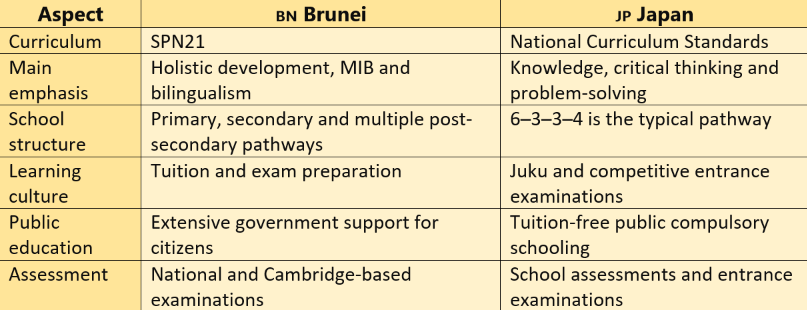
Side by side Comparison
Reference
Arofah, D., Arif, M., & Abdullah, H. (2026). A comparative analysis of the education systems in Brunei Darussalam and Indonesia: Curriculum, Islamic education, and character development. Edulab: Majalah Ilmiah Laboratorium Pendidikan, 11, 98–117. https://doi.org/10.14421/edulab.2026.111.07
OECD (2018), Education Policy in Japan: Building Bridges towards 2030, Reviews of National Policies for Education, OECD Publishing, Paris. https://doi.org/10.1787/9789264302402-en
Ministry of Education, Brunei Darussalam. (n.d.). Organisation chart. https://www.moe.gov.bn/organisation-chart/
Ministry of Education, Culture, Sports, Science and Technology. (n.d.). SEKI Yoshihiro: Minister of Education, Culture, Sports, Science and Technology. https://www.mext.go.jp/en/about/member/title01/detail01/1375567.htm
Written by